

INTRODUCTION
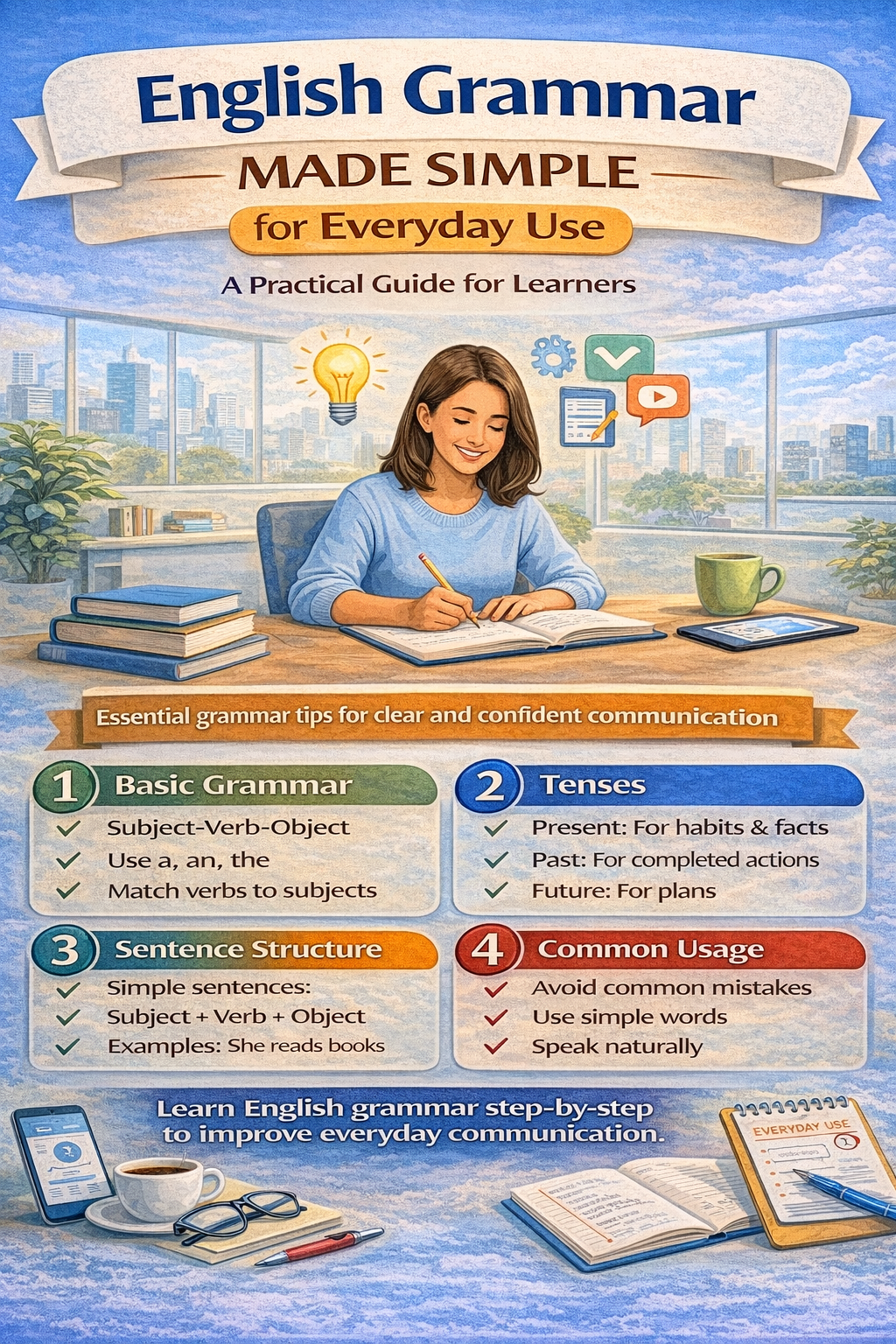
English grammar simple rules help learners communicate clearly and confidently in daily life. Many people fear grammar, but the truth is that everyday communication uses only a small part of English grammar.
This guide explains English grammar in a simple and practical way so learners can speak and write correctly without confusion.
1. Why English Grammar Should Be Simple
Grammar is not about memorizing complex rules. It is about:
- Making clear sentences
- Avoiding misunderstandings
- Communicating confidently
English grammar simple methods focus on usage, not theory.
2. Sentence Structure Made Easy
Basic English sentences follow a simple pattern:
- Subject
- Verb
- Object
Example:
She reads books.
Understanding this structure improves English grammar simple learning quickly.
3. Present, Past, and Future Tenses
Everyday English mainly uses three tenses.
Present Tense
Used for habits and facts.
Example: I work in an office.
Past Tense
Used for completed actions.
Example: I visited the market.
Future Tense
Used for plans.
Example: I will attend the meeting.
Focusing on these tenses keeps English grammar simple and effective.
4. Common Grammar Rules for Daily Use
Some basic rules include:
- Use articles correctly (a, an, the)
- Match subject and verb
- Use correct word order
These rules improve accuracy in daily communication.
5. English Grammar Simple for Spoken English
Spoken English does not require perfect grammar.
Focus on:
- Clear meaning
- Simple sentences
- Correct tense usage
English grammar simple approaches help learners speak without fear.
Spoken English: How to Speak Fluently and Confidently in 2026
6. Common Grammar Mistakes to Avoid
Avoid these frequent errors:
- Mixing tenses
- Missing verbs
- Incorrect plural forms
- Overusing complex sentences
Correcting these mistakes improves confidence.
7. Grammar for Professional Communication
Basic grammar matters in:
- Emails
- Reports
- Workplace messages
Using English grammar simple rules makes professional writing clear and polite.
8. Learning Grammar Through Practice
Grammar improves through use.
Effective practice includes:
- Writing short sentences
- Reading simple texts
- Speaking daily
- Correcting small errors
Practice builds long-term accuracy.
9. Grammar Learning Tips for Beginners
Beginners should:
- Learn one rule at a time
- Practice with examples
- Avoid overthinking
- Focus on communication
Simple learning brings faster results.
10. Role of Grammar in Communication Skills
Grammar supports communication skills by:
- Improving clarity
- Reducing confusion
- Building confidence
Grammar should help communication, not block it.
Communication Skills for Career & Daily Life: A Practical Guide for Success (2026)
11. English Grammar Simple Tools and Resources
Helpful tools include:
- Grammar apps
- Simple workbooks
- Online exercises
- Short videos
Choose resources that explain grammar simply.
12. Grammar Learning Trends in 2026
Modern grammar learning focuses on:
- Practical usage
- Spoken communication
- Short lessons
- Real-life examples
English grammar simple methods are becoming more popular worldwide.
FREQUENTLY ASKED QUESTIONS
Is English grammar difficult to learn?
No. Basic grammar is easy when learned step by step.
Is grammar important for speaking English?
Yes, but simple grammar is enough for daily communication.
Can adults learn English grammar easily?
Yes. Adults often learn faster with practical methods.
CONCLUSION
Learning English grammar simple rules helps learners communicate confidently in everyday situations. Grammar does not need to be complex to be effective.
Focus on clarity, practice daily, and use grammar as a tool to express ideas naturally.







[…] English Grammar Made Simple for Everyday Use: A Practical Guide for Learners (2026) […]